Formula details
Product Details
Overview
304 Stainless Steel Cutting Board with Brushed Finish and Handle Cutout
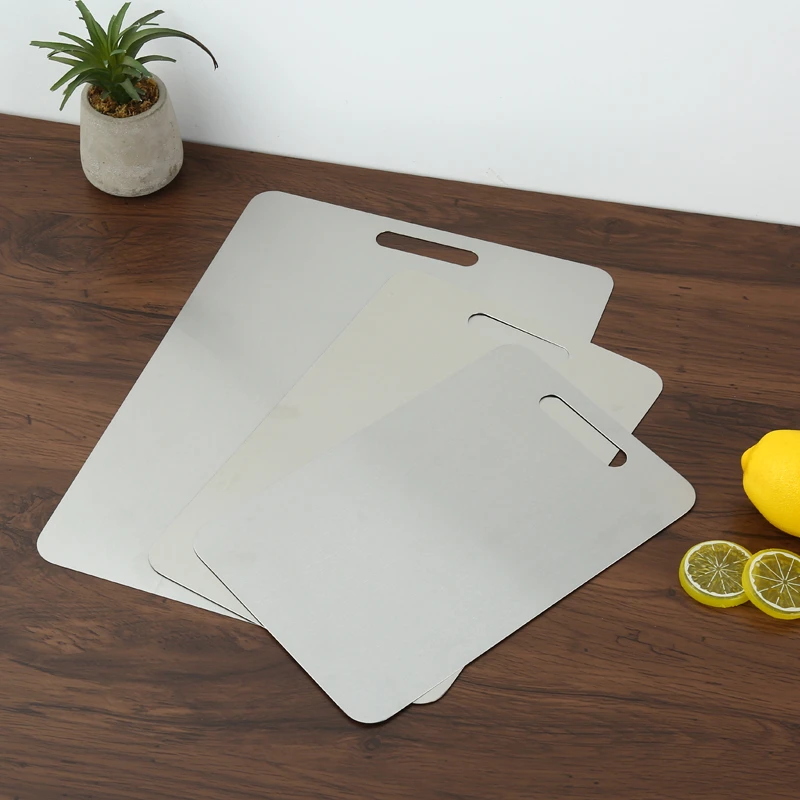
This 304 stainless steel cutting board is a food grade brushed 304 prep slab with rounded corners and an oblong handle cutout for carry or hang storage. Built as a multi-size chopping board set from solid 18 gauge 18/8 steel, it keeps a non-porous surface that is dishwasher safe, odor resistant, and ready for meat, produce, and dough prep.
| Specification | Technical Detail | Kitchen Performance |
|---|---|---|
| Material Composition | Certified 304 (18/8) Stainless Steel | Zero corrosion, zero microplastics, rustproof |
| Surface Finish | Directional brushed satin polish | Reduced blade glare, micro-groove resistance |
| Edge Geometry | Rounded corners with oblong handle cutout | Safe hand-off edges; hang or carry between stations |
| Core Thickness | Heavy-duty 18-gauge solid sheet | Zero warping under heavy cleaver strikes |
| Thermal Conductivity | High passive heat transfer (approx. 16 W/m.K) | 3x faster natural defrosting for frozen proteins |
| Sanitization | 100% dishwasher safe, boiling water safe | Commercial-grade heat and chemical tolerance |
Engineered for Everyday Performance
- Zero Microplastics & Pure Hygiene: Unlike plastic boards that shed polymer shards into your food, our solid metal surface never flakes, pits, or grooves. Juices, blood, and pungent marinades stay on the surface for instant wipe-down cleaning.
- Oblong Handle Cutout: Each board includes a precision-cut handle opening near the top edge for carrying between stations or hanging storage. An optional silicone non-slip backing mat keeps the slab planted during carving and kneading.
- Knife-Considerate Brushed Satin Finish: The surface features a micro-textured brushed finish calibrated to yield slightly under blade pressure. This mechanical treatment prevents micro-burrs on your knife edges while masking everyday cosmetic cut lines.
- Rapid Thermal Defrosting: Taking advantage of raw steel's high thermal transfer rate, this board doubles as an unpowered thawing tray, pulling ambient room heat into frozen meats to cut thaw times in half without cooking the edges.
Size Selector: Choosing Your Prep Surface
- Small / Medium Everyday Prep (15.7" x 11.8" and 19.7" x 15.7"): Ideal for apartment kitchens, daily vegetable dicing, fruit slicing, and sandwich prep. Nested sizes store flat and fit residential dishwashers.
- Large Chef Slab (23.6" x 15.7"): Designed for full briskets, whole poultry, oversized pastry dough, and heavy holiday prep across large counter spaces.
Why Food-Grade 304 Stainless Steel Beats Cheaper Alloys
Every 304 stainless steel cutting board uses certified 18/8 metallurgical stock because low-cost alternatives degrade quickly under daily kitchen conditions. When working with raw proteins, acidic marinades, and heavy moisture, the exact alloy composition directly impacts kitchen safety.
Material Grade Science: 304 (18/8) vs. 201 and 430
Many discount boards use low-tier 201 or 430 steel to cut raw material costs. The chemical differences dictate how the board performs over years of chopping:
- 304 (18/8) Food-Grade Steel: Contains roughly 18% chromium and 8% nickel. This specific ratio generates a robust, passive chromium-oxide surface film that prevents corrosion, withstands citrus acids, and resists dishwasher detergents.
- 201 Stainless Steel: Swaps expensive nickel for cheap manganese and nitrogen. It corrodes rapidly when exposed to table salt or lemon juice, causing surface pitting and rust spots within months.
- 430 Stainless Steel: A ferritic alloy containing no nickel. While hard, it lacks the elasticity needed for knife work and oxidizes readily if left damp on a kitchen counter.
When choosing a commercial-grade custom stainless steel cutting board, certified 304 alloy is the baseline standard for structural stability and certified food contact.
Zero Microplastics, Mold, and Deep Food Grooves
Standard plastic boards shed microplastic fibers directly into minced garlic, herbs, and meat with every slice. Over time, both plastic and wood surfaces develop micro-scars that harbor bacterial colonies and mold spores that soap cannot reach.
- Impermeable non-porous surface: Liquid, blood, and juices stay on top rather than soaking into the core.
- No microplastic shedding: Keeps synthetic polymers completely out of your family's food supply.
- Anti-mold defense: Unlike bamboo or end-grain wood, the metal dries completely within minutes, denying black mold the damp environment it needs to grow.
Natural Odor Neutralization
Pungent kitchen staples like garlic, onions, shallots, and fresh fish release sulfur-based compounds that bond tightly to porous cutting surfaces.
The chromium in our 18/8 steel acts as an odor resistant cutting surface. When you rinse the board under cool tap water, the metal naturally binds to and neutralizes these sulfur molecules. You can break down whole mackerel, rinse the board for thirty seconds, and immediately slice ripe strawberries without any residual flavor transfer.
Handle Cutout Design and Double-Sided Prep Surfaces
A cutting board should move cleanly between stations and stay easy to store. This 304 stainless steel cutting board combines an oblong handle cutout with a true double sided layout so one slab handles aggressive knife work and delicate baking with equal precision.
Oblong Handle Cutout for Carry and Hang Storage
Nothing slows a prep line faster than a board that is awkward to lift or store. The oblong handle cutout keeps each 304 stainless steel cutting board easy to carry to the sink or hang between stations.
- Carry and hang: The oblong cutout lets staff lift the board cleanly or hang it on a hook between shifts.
- No fragile glued feet required: The flat steel sheet cleans in the dishwasher without rubber feet that trap grime or fall off.
- Stable prep workflow: Pair the slab with an optional silicone non-slip backing mat when slicing a heavy roast or rolling stiff dough. For specialized counter layouts, see custom non-slip cutting boards.
Side A: Brushed Surface for Raw Meat Carving and Heavy Butchery
The primary working face features a directional brushed finish designed specifically for high-moisture prep work:
- Micro-texture grip: The subtle grain of the brushed surface keeps wet, slippery meats-like pork tenderloin, whole poultry, and fish fillets-from skidding under the knife blade.
- Liquid containment: Blood, brines, and meat juices sit directly on the non-porous face without penetrating the core, eliminating bacterial buildup.
- Surface resilience: The directional grain naturally masks fine tool marks over extended daily use, preserving the clean look of your prep surface.
Side B: Ultra-Smooth Finish for Dough Rolling and Pastry Prep
Flip the board over, and the reverse side serves as a dedicated, mirror-smooth pastry and prep table:
- Naturally cool working surface: Stainless steel maintains room temperature or lower, preventing butter from melting into pie crusts, laminations, and cookie doughs.
- Effortless release: The smooth metal surface requires far less bench flour for kneading bread, flattening pasta sheets, or shaping delicate pastries.
- Zero flavor transfer: Garlic and onion residues from butchery stay on Side A, guaranteeing that your sweet pastries, fondant, and fresh doughs remain completely uncontaminated.
Laser-Chamfered Corners and Deburred Edges
Working with sheet metal requires strict fabrication standards to keep handling safe and comfortable. We run every single board through a multi-stage edge-finishing line before final inspection:
- CNC laser-chamfered corners: All four board corners feature rounded, radius-cut profiles that eliminate sharp right-angle points.
- Continuous mechanical deburring: We radius and polish all perimeter cut edges to remove micro-burrs and sharp factory flashings.
- Ergonomic grip: The smooth, hand-finished perimeter allows you to pick up, flip, wash, and store the heavy metal slab quickly without snagging your hands or scratching stone countertops.
Blade Sharpness, Kitchen Noise, and Surface Scratching Facts
Switching to a 304 stainless steel cutting board brings up practical questions about blade wear, kitchen acoustics, and cosmetic marking. We believe in total transparency about how metal prep surfaces interact with cutlery so you get the best performance from your tools.
Knife Edge Reality: Practical Blade Maintenance and Slicing Mechanics
A common concern is that steel immediately ruins an edge. In metallurgy, 304 stainless steel has an austenitic structure that sits significantly lower on the Rockwell scale (approx. 70-85 HRB) than high-carbon kitchen knives, which typically test between 56 and 62 HRC. The blade is substantially harder than the board.
- Slicing vs. Hacking: A smooth push-cut or pull-cut slice keeps your edge aligned. Avoid heavy hacking or excessive lateral twisting with thin-profile Japanese blades.
- Routine Honing: A quick pass on a ceramic or steel honing rod every few sessions realigns micro-bevels instantly. In our independent kitchenware manufacturing case studies, German-style chef knives used with standard slicing motions retained functional working edges across standard weekly meal prep cycles without accelerated chipping.
Acoustic Dampening with Optional Non-Slip Silicone Mat
Metal against hard stone surfaces can create ringing vibrations. Targeted acoustic isolation with an optional silicone mat solves this:
- Vibration Absorption: Placing our textured silicone non-slip mat directly beneath the steel board absorbs acoustic transfer, muting the sound of the blade strike down to a low, muted tap comparable to dense end-grain wood.
- Counter Grip: The dampening layer also locks the board flat, eliminating board walk and table rattle when handling fast knife work.
Normal Cosmetic Scratches vs. Non-Porous Hygienic Integrity
Your board will develop faint surface patina marks over time. It is vital to understand the difference between aesthetic wear and sanitary performance:
| Feature | 304 Stainless Steel Cutting Board | Traditional Plastic / Wood Boards |
|---|---|---|
| Surface Scratch Depth | Microscopic surface marks only | Deep gouges, tears, and fibrous fissures |
| Bacterial Harboring | Zero; surface stays non-porous | High; bacteria nest in cut valleys |
| Material Degradation | No material transfer or shedding | Microplastic shedding and wood rot |
| Visual Longevity | Brushed satin patina that lasts decades | Stained, scarred, and bowed surfaces |
Surface scratches on a food grade metal prep surface do not compromise structural density. Because the metal cannot crack, absorb moisture, or splinter, bacteria and food juices have nowhere to hide, ensuring rapid, reliable sanitization every single time you clean.
Versatile Culinary Applications for Your 304 Stainless Steel Cutting Board
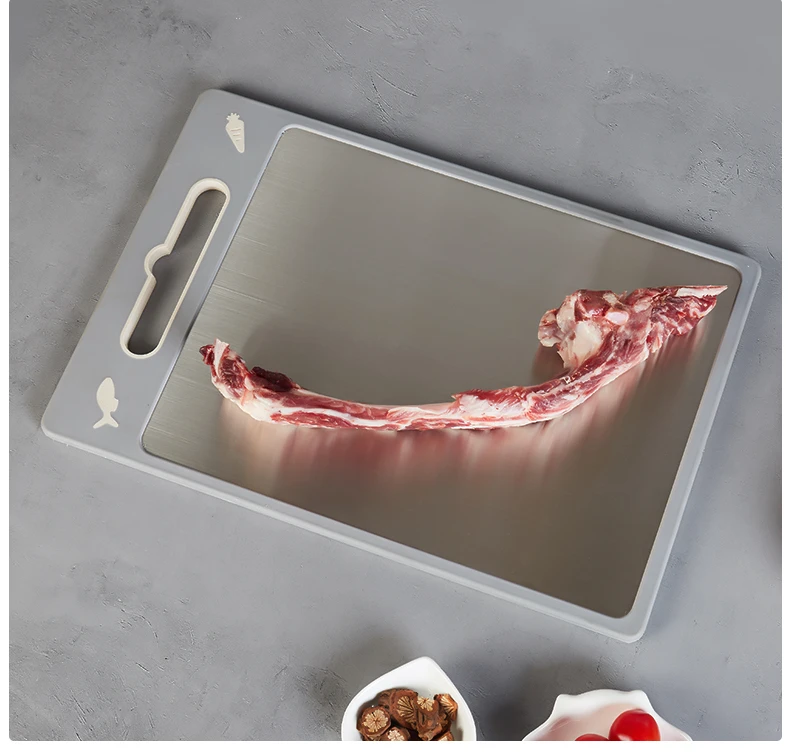
A solid 304 stainless steel cutting board is more than a standard slicing block. The slab addresses temperature, hygiene, and cleanup challenges across three core kitchen tasks.
Zero Cross-Contamination Station for Raw Proteins
Prepping raw poultry, brisket, and seafood demands strict sanitation. Unlike porous wood or scarred plastic blocks that absorb fluids, our steel board provides a certified non-porous surface that blocks meat juices, blood, and pathogens from entering the material.
- Hygienic barrier: Bacteria cannot colonize or hide beneath surface cuts.
- Instant turnover: Wash the board with hot water and dish soap between proteins with zero lingering raw odors.
- Tested durability: Built to meet strict certifications and testing standards for commercial food-contact safety.
Naturally Chilled Pastry Board for Butter-Rich Dough
Managing dough temperature determines the flaky layers in pie crusts, puff pastries, and fresh laminated pasta. Our board doubles as an exceptional stainless steel pastry board thanks to the thermal density of solid 18/8 metal.
Place the slab in your refrigerator or freezer for 15 minutes before rolling dough. The retained cold prevents butter from melting into the flour, reduces stickiness, and eliminates the need to dump heavy coatings of extra flour onto your work area.
| Culinary Task | Conventional Board Issue | 304 Stainless Steel Advantage |
|---|---|---|
| Raw Poultry & Fish | Juices seep into knife grooves, causing bacteria build-up | Non-porous metal prevents liquid entry and wipes completely clean |
| Pastry & Laminated Dough | Room temperature surfaces soften butter too quickly | Pre-chillable metal maintains cold dough structure without sticking |
| Thawing Steaks & Fillets | Sitting in pooled liquid; slow defrosting on wood or plastic | High thermal transfer pulls ambient heat to passively defrost proteins |
Rapid High-Conductivity Thawing Tray
You do not need a separate single-use thawing tray taking up drawer space. This slab functions naturally as an efficient stainless steel thawing tray board via basic thermodynamics.
Solid steel conducts heat rapidly from the surrounding room directly into frozen items. Placing frozen chicken breasts, vacuum-sealed steaks, or fish fillets flat against the metal cuts passive defrosting time significantly compared to wood or plastic plates, all without hot spots or microwave pre-cooking.
Technical Product Matrix and Dimensions for 304 Stainless Steel Cutting Boards
Every 304 stainless steel cutting board is built for structural rigidity without unnecessary kitchen bulk. Below is the metallurgical matrix, sizing parameters, and thermal tolerances that define these food prep surfaces.
Heavy-Duty 18-Gauge Solid Core Thickness
We build these boards with a calibrated heavy-duty 18-gauge (1.2 mm) solid steel core, balancing rock-solid butchering stability with lightweight daily handling. Unlike thin sheet wraps, this solid core refuses to bow or dent under heavy mallet impacts. For custom industrial sizing or tailored commercial thicknesses, our engineering team handles end-to-end specifications through our product development solutions.
Dimensional Sizing, Weight Balance, and Handle Cutout
The oblong handle cutout and rounded corners keep the board easy to lift and store during aggressive slicing and heavy dough kneading.
| Specification | Medium Prep Slab | Large Chef Slab | Extra-Large Master Board |
|---|---|---|---|
| Dimensions (L x W) | 15.7 x 11.8 in (40 x 30 cm) | 19.7 x 15.7 in (50 x 40 cm) | 23.6 x 15.7 in (60 x 40 cm) |
| Material Gauge | 18-Gauge (1.2 mm) | 18-Gauge (1.2 mm) | Heavy 16-Gauge (1.5 mm) |
| Handle Cutout | Oblong hang/carry opening | Oblong hang/carry opening | Oblong hang/carry opening |
| Net Weight | 2.6 lbs (1.18 kg) | 4.2 lbs (1.91 kg) | 5.8 lbs (2.63 kg) |
| Edge Geometry | 1.5 mm Laser Deburred | 1.5 mm Laser Deburred | 1.5 mm Laser Deburred |
| Finish (Side A / Side B) | Brushed Satin / Smooth Polished | Brushed Satin / Smooth Polished | Brushed Satin / Smooth Polished |
Sanitization Compatibility and Thermal Thresholds
Because our food-grade metal lacks organic adhesives, plasticizers, or wood pores, it tolerates extreme commercial sterilization environments:
- Residential & Commercial Dishwashers: 100% dishwasher safe. Handles 180°F (82°C) sanitize wash cycles and prolonged heat-dry sequences without thermal warping.
- Boiling Water Flushes: Safe for direct scalding water rinses to flash-sterilize greasy surfaces after cutting raw poultry and seafood.
- UV Sterilization Chambers: Fully impervious to structural UV degradation, ozone treatments, and commercial restaurant sanitizing solutions.
- Thermal Range: Safe for direct contact with frozen proteins down to -40°F (-40°C) and hot cookware up to 500°F (260°C).
Cleaning, Descaling, and Maintaining Your 304 Stainless Steel Cutting Board
Keeping a 304 stainless steel cutting board pristine requires a fraction of the time and effort demanded by traditional wood, bamboo, or plastic slabs. Because the metal is completely non-porous, grease and liquids sit on top rather than absorbing into deep knife scars.
Fast 30-Second Wash Routine
Cleaning up after raw meat prep or greasy carving takes under a minute:
Rinse immediately: Run warm water over the board to flush away surface scraps.
Soap and wipe: Add a drop of standard liquid dish soap onto a standard sponge or dishcloth and wipe across the brushed finish.
Quick dry: Rinse clean and stand it upright or wipe dry with a clean kitchen towel. It is also 100% dishwasher safe, so you can slide it straight into the lower rack for high-heat sanitizing cycles without worrying about warping.
Vinegar Rinse Protocol for Hard-Water Spots
Depending on your tap water's mineral content, you may occasionally notice faint white spots or limescale film on the steel surface. Restoring the factory shine is effortless:
The solution: Mix equal parts warm water and distilled white vinegar (or fresh lemon juice).
Application: Wipe the surface with a soft microfiber cloth soaked in the vinegar solution.
Wait and rinse: Let it rest for 60 to 90 seconds to dissolve calcium and mineral deposits, then rinse with fresh water and dry thoroughly.
Zero Oiling, Sanding, or Chemical Resurfacing
Wood blocks demand monthly treatments with food-grade mineral oils and beeswax to prevent cracking. Plastic boards require scraping or sanding once micro-grooves harbor black mold colonies.
Our solid 304 stainless steel cutting board eliminates that maintenance routine entirely:
No conditioning: Never buy board creams, butcher block oils, or chemical sealants.
No splintering or shaving: The surface will never produce splinters, peel, or shed microplastics into your prep work.
Indefinite structural life: Whether used in a home kitchen or engineered as commercial-grade custom cutting boards, the metallurgical composition remains completely impervious to rot, water saturation, and high-temperature cleaning.
304 Stainless Steel vs. Plastic, Wood, and Glass Cutting Boards
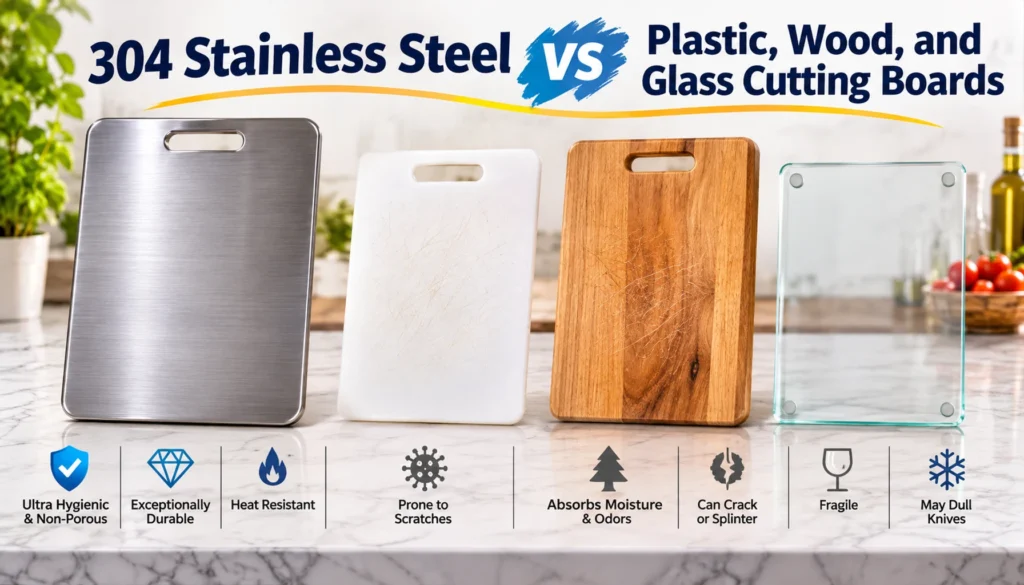
Every prep surface comes with trade-offs, but material performance directly impacts everyday kitchen hygiene and longevity. We put a 304 stainless steel cutting board side by side with traditional plastic, butcher block wood, and tempered glass to see how they hold up to heavy prep work.
| Prep Surface Material | Porosity & Odor Retention | Microplastic / Particle Shedding | Warp & Crack Resistance | Sanitation & Care |
|---|---|---|---|---|
| 304 Stainless Steel | Non-porous; zero absorption | Zero shed particles | Will not split, warp, or crack | 100% dishwasher safe; boiling-water ready |
| Plastic (HDPE / PP) | Deep knife grooves harbor odors | High risk of microplastic ingestion | Prone to deep scarring and bowing | Dishwasher safe, but scars harbor bacteria |
| Wood & Bamboo | Absorbs blood, juices, and moisture | Splinters and fiber shed | Warps, splits, and rots over time | Hand-wash only; requires continuous oiling |
| Tempered Glass | Non-porous; slick surface | Zero particles (high shatter risk) | Can shatter into shards if dropped | Blunts and rolls knife edges instantly |
Stainless Steel vs. Plastic: Ending Microplastic Ingestion and Cut Scars
Standard plastic boards scar quickly under regular slicing. Over months of use, sharp chef's knives leave serrated furrows that trap raw poultry juices, foul smells, and grease. Worse, mechanical friction flakes microplastics directly into your minced meat and vegetables.
While we produce commercial-grade options like custom plastic cutting boards for high-impact industrial hacking, our 304 stainless steel cutting board solves the microplastic issue entirely. Its high-density, non-porous surface resists gouging. Blade contact will leave shallow cosmetic burnish lines on the metal, but it never sheds micro-shreds or forms bacteria-trapping trenches.
Stainless Steel vs. Wood and Bamboo: No Warping, Splintering, or Rotting
Traditional end-grain and edge-grain butcher blocks absorb fluids instantly. If you cut raw seafood or marinating steaks, organic liquids seep straight into the wood fibers. Leaving a wood board wet causes it to swell, twist, and eventually crack down the glue lines.
Our food-grade 304 steel contains zero glues, resins, or porous cellular pathways:
Zero rot: Water cannot penetrate the solid 18-gauge steel core, meaning it never rots or develops black mold mildew.
Immune to steam and heat: You can drench it in rolling boiling water or scrub it aggressively without causing the structural warping that destroys expensive bamboo slabs.
Maintenance-free: You never have to sand down the face or apply monthly coats of food-grade mineral oil.
Stainless Steel vs. Tempered Glass: Shatterproof Safety and Knife Edge Preservation
Tempered glass is frequently marketed as hygienic, but it is one of the worst surfaces for fine kitchen cutlery. Glass has a mineral hardness that is significantly higher than premium cutlery steel (HRC 56-62). Striking a glass board rolls, micro-chips, and dulls razor-sharp blade edges in just a few prep sessions. Glass also presents a severe safety hazard if dropped onto tile floors or subjected to thermal shock.
Food-grade 304 stainless steel offers a vastly superior balance:
Shatterproof durability: It will never chip, crack, or break into hazardous shards, even if dropped from counter height.
Blade-forgiving yield: The steel exhibits a lower surface hardness than tempered glass, preserving the edge alignment of quality knives when using smooth slicing techniques.
For restaurant kitchens and retail brands sourcing durable food prep lines, exploring our catalog of wholesale cutting boards provides commercial-grade steel solutions built to replace worn-out prep boards permanently.
Custom Sizing and OEM/ODM Manufacturing Capabilities
We are a professional cutting board manufacturer and OEM/ODM kitchenware supplier, engineering tailored culinary surfaces for global retailers, private labels, and commercial kitchens. Every 304 stainless steel cutting board leaving our facility is built to strict international food-contact benchmarks, supported by our documented manufacturing quality controls and full metallurgical traceability.
Factory Standards and Metallurgical Compliance
We eliminate alloy inconsistencies by strictly processing certified 18/8 austenitic stainless steel. Our production lines combine precision fiber-laser cutting, automated deburring, and CNC folding to deliver consistent commercial-grade finishes:
- Spectrometer Material Verification: Every coil undergoes Positive Material Identification (PMI) testing to verify genuine 18% chromium and 8% nickel content with zero heavy metal contaminants.
- Flawless Edge Finishing: High-speed CNC deburring machines smooth all cut edges, followed by laser-chamfered corners to ensure user safety during high-volume prep work.
- Controlled Satin Brushing: Industrial mechanical polishing creates a uniform, knife-friendly brushed finish that masks daily wear while maintaining a strictly non-porous surface.
Custom Branding, Dimensions, and Gauge Selection
Through our flexible custom solutions, we develop bespoke prep boards configured to your precise brand requirements and market preferences:
- Custom Dimensions and Profiles: We manufacture standard retail sizes, extended bakery surfaces, and large-format butcher slabs with customized counter edge lip depths.
- Gauge and Thickness Options: Select the right steel profile for your audience, ranging from agile 1.5mm consumer models to heavy duty 18 gauge (1.2mm) and reinforced 2.0mm commercial slabs.
- Precision Fiber-Laser Etching: Add permanent brand logos, metric/imperial measurement grids, or custom artwork without disturbing surface smoothness or creating crevices for bacteria.
- Turnkey Packaging: Choose retail-ready gift boxes, barcode labeling, edge corner protectors, and custom-molded non-slip silicone mats ready for direct distribution.